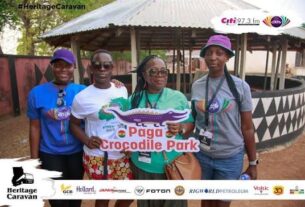

Paga is the capital of the Kassena Nankana West District, and lies 40km from Bolgatanga, the Upper East Regional capital. The fast growing town lies on the border between Ghana and Burkina Faso and is the gateway between Ghana and Burkina Faso, Mali and the rest of the Sahel region. The main language spoken in and around Paga is Kassem, which is also spoken in Navrongo, Chiana and Nakolo in Ghana and Po, Tibele, and Kaya in Burkina Faso. The larger Kassena ethnic group is believed to have first emerged from the Yo River Basin near Kampala (in Burkina Faso). They stayed briefly around the river and moved to Kampala itself. It is in Kampala that the patriarch of modern day Paga, Nave (pronounced Naveh) was born. He was born to Panlugu, a prince of Kampala and lived in Kampala in his early years. Kampala, today is a small village in the Po Department (District) of the Nahouri Province in present day Burkina Faso.
The Dog Scandal
As tradition indicates, one day Nave trapped and captured a wild puppy and trained it into a good hunting dog. It became his faithful companion and pampered the pet rather too much. The dog was a constant companion of Nave as they did everything together; – hunting, walking, eating and even sleeping. Nave’s friendly relation with his pet did not only arouse jealousy among his brothers but also, the dog equally aroused their appetite for its meat.
One evening, Nave got informed that the gods and ancestors of the land had demanded a sacrifice for the prosperity and good health for the people. He further learnt that his siblings had plans to use his dog for the sacrifice. Knowing this and confronting his family members created bad blood. He threatened leaving his ancestral home if they ever killed his dog. From that point onwards, he kept a close eye on his dog. As fate would have it, one day, the dog fell ill and could not go hunting with its master. As it lay helpless in the hut, it was slaughtered and the meat shared among family members with some reserved for dog owner; Nave.
When Nave finally returned to the family compound, sensing the insecurity of his dog, he quickly made his way to his hut to check on the condition of his “friend”. But to his great disappointment, the dog was nowhere to be found. Livid, he accosted his brothers who insisted the sacrifice had to be performed otherwise calamity would befall the family. That night he bravely fulfilled his promised and threat – he would flee Kampala and never look back.
A Journey that Determined History
While packing his belongings and hunting gear and cursing his brothers, a quick family meeting was convened. He threatened to shoot his elder brother with the arrows in his quiver if he dared persuading him any further. Words from his father, and later his mother, meant nothing. He had had enough. The next dawn was the beginning of a long, thorny fate-determining journey.
Days of barefoot trekking along the hyena infested savannah with no sign of human civilization nearby gradually transformed the sturdy and optimistic hunter into a feeble pessimistic thirsty figure. It was a moment of regret and Nave begun to yield to fate. He missed home and friends but resolved he was not going back. He would rather die and be erased from history than return home with his head down.
Encounters with Crocodiles
He trudged himself into the comfort of the shade of tree, sitting in wait of death, a sudden rustle of leaves ahead of him gave him some long forgotten energy and verve to sit up. He observed a big Nile crocodile a few metres ahead of him. The hunter in him led him to quickly figure out that there would be a water body nearby. With all the energy left in him, he drew closer to the crocodile which hurriedly sought refuge and as he followed, he eventually reached a large pool of clear water. Nave took a long deep life-saving drink and a nap. A life saved and a whole generation spared. He picked up the pieces from there.
The lifesaving encounter and other subsequent encounters, some of which are summarized here, led Nave to decree, all his descendants shall protect crocodiles and consider the eating of their flesh as taboo – equivalent to eating human flesh.
With renewed energy, the journey continued. One sunny morning he chanced on a village with numerous huts. Pindaa, situated west of present day Paga was his first contact with human civilization since leaving Kampala and they were a welcoming lot. The Chief of Pindaa gave him shelter in his palace and helped him settle down. Nave’s hunting skill and frequent killing of big game from hunting for communal sharing made him all the more liked.
When the weariness of adventure disappeared, he found and married a woman from Chiana by name Kavugu. This marriage of Nave and a woman from Chiana is oft referred to as the source of bonding and unity between Paga and Chiana. He also married a woman from Pindaa Bavonia from a man named Avogo. Beginning with their first son, Kanlaa, Nave soon had a fairly large family. This led to a competition for resources between the immigrant family and those of the indigenes especially with the chief’s family as they were housed in the same palace. Not a stranger to moving away from home and feeling like he had become an inconvenience to his hosts, Nave decided he would relocate his family to a new home. Though sad, the Pindaa chief and his Council of Elders approved of the decision. He was subsequently given the opportunity to locate any area he liked and relocate when he was ready.
The Birth of Paga
While in search for a place to settle and call a new home, a number of things connived to provide a solution. He met and made a new friend during his hunting expeditions who at the time had no family. They could chat for hours on end and share food and drink but this new friend would neither disclose his name nor his home. With time, Nave decided he would refer to him as an ant – in reference to his (friend’s) earlier mention that he lived in a hole somewhere. Thus, this great friend of his got into the oral traditions and history of Paga as Namina (a colloquial word for mimina (ant in Kasem)). Namina’s great friendship helped him opt to move eastwards from Pindaa in search of a new home. But that was not the only factor, on one occasion, while returning from a hunting trip and extremely thirsty, a very beautiful lady who was fetching water near a pond offered him a calabash of water accompanied by a seductive smile. He deliberately visited the pond severally, afterwards, hoping luck would smile on him to be able to strike a conversation with the young lady but never saw her again. His conclusion hence was that the young lady was actually the spirit of the pond. He described her (and hence the pond) as young virgin – Katogo (pronounced Katɔgɔ). Till date, Katogo is a highly revered pool of water in Paga.
Nave also chanced on other ponds Chura and Cho-buga. The location and arrangement of these three ponds; Katogo, Chura and Cho-buga and the presence of other physical features, trees and rocks, were similar to a section of Kampala and reminded him very much of home.
Not far from these natural phenomena, he had recently subdued a buffalo. The area was rich in flora, fauna and water. He climbed up a small hill surveyed his environment and came to one conclusion – the gods of Kampala had followed him and made here their new home. He then made that now famous declaration “A yi paɣ yo”. [translated; Here, my eye is pleased]. The hill on which he made the declaration is known till date and situated in the forest reserve between Nania and Kayilo.
He thus chose to settle his family where he had earlier killed the buffalo named and their new home Gania (also, Nania). Nania thus became the nucleus and first settlement of Paga. Although Nave preferred to call his new home Nania, his descendants continued to refer to it as the place which pleased their eyes (Paga, for short) with Nania referring to the specific location where Nave settled.
By the time Nave and family relocated to their new home in Nania, his old friend, Namina, had had his own family of one son and three daughters. Some traditions have it that Nave’s sons married some of Namina’s daughters. Namina’s lineage survived for 11 generations each time with a male son and several females until the current surviving family which has three (3) sons.
The Genesis of Chieftaincy in Paga
In addition to the first son Kanlaa, Nave was blessed with other sons namely, Kum, Namuamuri, Badinu, Chamwuru and others. They grew from a nuclear family into a clan with natural leadership emanating from Nave as patriarch. As old age stared him in the face, leadership of the family also became a cause for concern and when he eventually died, a vacuum was created. The tradition has it that, Kum [so named because Nave had killed a deer (Kun in Kasem) the day he was born] was a young man who could hardly stay home. He preferred to spend most of his time at his matrilineal uncle’s home in Chiana.
Consequently, Kum’s brothers were often worried about his constant absence from home. This was in the era of slave raiders and the terrain was largely a wilderness. His brothers therefore sought to pin him down with responsibility.
One day, on the return of their brother Kum from his usual trek to Chiana, they summoned him for a meeting and as destiny would have it, they told him that after having consulted a soothsayer, it was revealed that Nave, their late father, had requested that he, Kum, be given full control of the large family. In addition he would bear responsibility of being present at all times, sitting in state to settle family disputes, sacrificing to the Kwara (the embodiment of the royal clan’s spiritual power and authority) and be head of the new Nave clan. In summary, he was told that his father wanted him to be chief. After some rites were performed, Kum officially and spiritually became first in the genealogy of chiefs of Paga.
The Formation of Suburbs of Paga.
Due to congestion in the now large household, competition for resources was unavoidable and in order to solve this, all the sons of Nave decided to space out and find new homes. Kanlaa who was the eldest decided to remain in Nania. Kum (now Chief) moved about a mile east and settled at Kakungu. Chanwura settled a little further ahead of Kakungu on a hill and called it Zenga (hill). Badinu another brother also moved further south east and called his settlement Badunu (after his name). Namuamuri also moved out and settled a few hundred yards to the west of Kakungu and gave origin to the present settlement of Babile (This was after prior attempts to settle in other locations. When he tried settling in Babile, he was once again advised to relocate to a better place because his preferred location was a marshy area. He protested by saying they should stop moving him around (bibili in Kasem).
The five settlements: – Kakungu, today is the Centre of administration and commerce, while Zenga, Babile, Nania, Badunu form the core of Paga Traditional Area.
The Sacred Crocodiles
Earlier, it was stated Nave escaped death having been saved by a crocodile. Consequently, he made it a taboo to harm or eat a crocodile. It wasn’t this one-time event which led to the crocodile being accorded taboo status in Paga and, therefore, sacred.
In another of Nave’s hunting expeditions, after days of roaming in the wilderness without any game in sight. He sat down to relax and restrategise. While at rest near a pond, he noticed it was a safe haven for numerous crocodiles. He considered himself fortunate. With stealth, he trapped and killed one and carried it home with all the feeling of a victor. Upon arrival, he was hit with the sad news that one of his sons had just died. He (son) was previously very well.
Few days later, he lost another son and not long after, another.
By this time Nave was compelled to consult a soothsayer for an explanation for the consecutive deaths. It was then revealed to him that his new-found hunting ground was the root cause. The oracles had it that:
1. The crocodiles are the embodiments of the spirits of his children therefore death of a crocodile meant a corresponding death of his son.
2. The flesh of the creature should never be eaten.
3. The creatures should be revered for the welfare and prosperity of his new found settlement.
Did you know…
It is against the bye-laws of Kassena-Nankana West District Assembly to trap or harm a crocodile.
The friendly crocodiles attract thousands of visitors and tourists every year.
The people of Kayilo are responsible for outdooring new over lords of Paga.
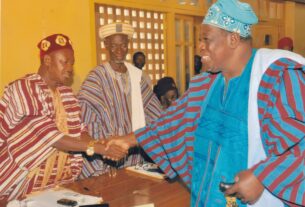
Pε Awampaga Tedam (1938 – 1971) introduced the concept of Paramountcy to Paga. He had prior to that enskinned several divisional chiefs in line with the growing number and needs of the society.
Pε Awampaga Tedam formalized trade in Paga by building market stalls and declaring it the common place for the trading of goods. This was completed in 1948.
Pε Awia Awampaga II was the first to hold office as the President of the Upper East Regional House of Chiefs for two consecutive terms (1995—2007).
à Pε Awia Awampaga II instituted the public celebration of Fao Festival in Paga
What do you feel about this post?

Like

Love

Happy

Haha

Sad